

Product details
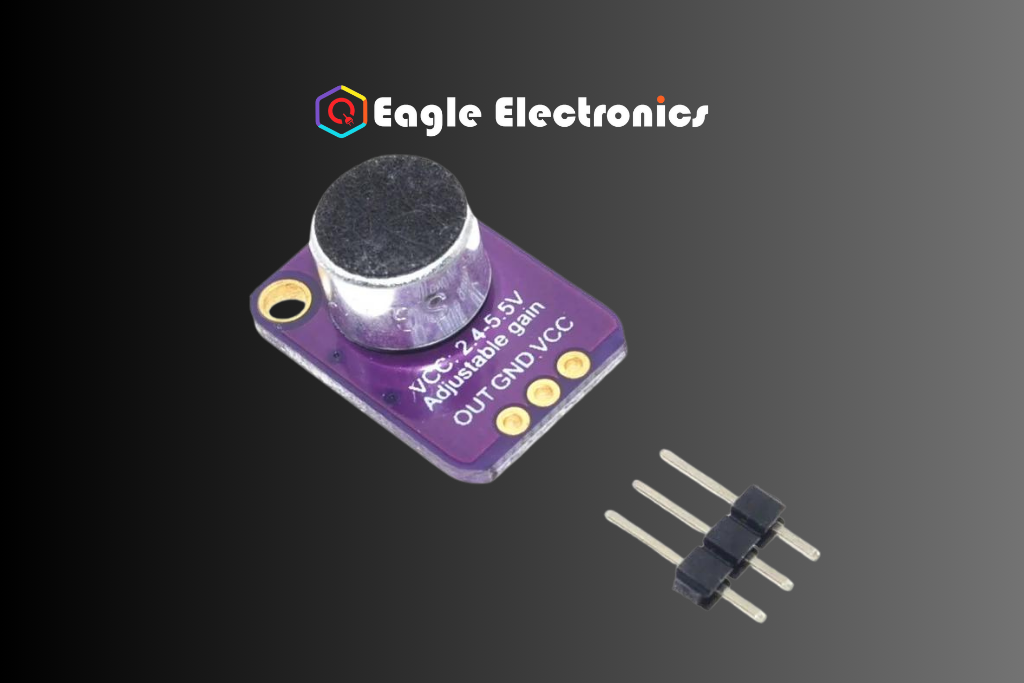
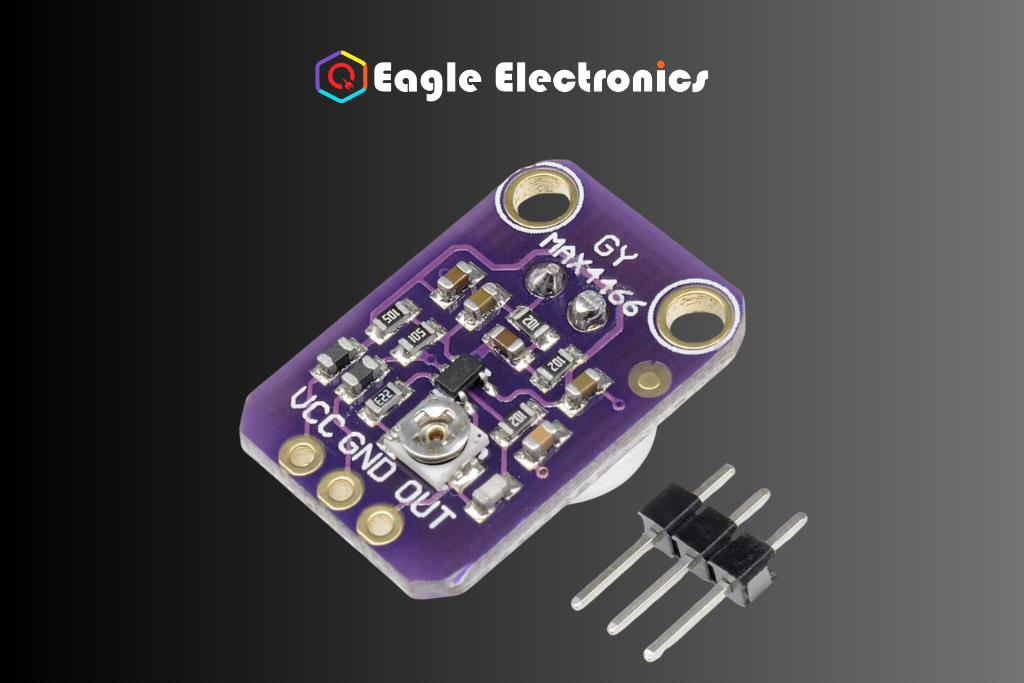
The MAX4466 Electret Microphone Amplifier with Adjustable Gain Module is completely completed. The tested board includes a 20–20KHz electret microphone that has been soldered on. For the amplification, we use the Maxim MAX4466, an operational amplifier specifically engineered for this sensitive task. The amplifier possesses an exceptional ability to reject power supply noise, resulting in high-quality sound without the typical background noise or distortion found in other microphone amplifier breakouts we have tested.
This MAX4466 Electret Microphone Amplifier with Adjustable Gain Module is ideal for applications like voice modifications, audio recording and sampling, and audio-reactive projects that utilise FFT. On the rear, we incorporate a little trimmer potentiometer to modify the amplification. You can adjust the amplification level from 25 times to 125 times.
That amounts to approximately 200 millivolts peak-to-peak (for a typical speaking volume at a distance of about 6 inches), which is suitable for connecting to a device that requires a ‘line level’ input without distortion, or up to about 1 volt peak-to-peak, which is appropriate for reading from a microcontroller ADC. The output is capable of reaching the whole range of voltage, so if the sounds get loud, the output can reach a maximum of 5 volts peak-to-peak.
Specifications
- Supply Voltage Operation: +2.4V to +5.5V.
- Input Current (A): 24
- Gain Bandwidth Product (KHz): 600
- Phase Margin (Degrees):70
- Gain Margin (dB):20
- Versions with 5nA Complete Shutdown Available only (MAX4467/MAX4468).
- Excellent Power-Supply Rejection Ratio: 112dB.
- Excellent Common-Mode Rejection Ratio: 126dB.
- High AVOL: 125dB (RL = 100kΩ).
- Rail-to-Rail Outputs.
- Low 24A Quiescent Supply Current.
- Gain Bandwidth Product:
200kHz (MAX4465/MAX4467/MAX4469)
600kHz AV 5 (MAX4466/MAX4468) - Size: 20 x 14 x 8mm
- Weight: 2g.
How to Use:
- Connect GND to ground, VCC to 2.4-5VDC.
- The audio waveform will come out of the OUT pin. The output will have a DC bias of VCC/2 so when it’s perfectly quiet; the voltage will be a steady VCC/2 volt (DC couple).
- If the audio equipment you’re using requires AC coupled audio; place a 100uF capacitor between the output pin and the input of your device.
- If you’re connecting to an audio amplifier that has differential inputs or includes decoupling capacitors; the 100uF cap is dont require.
- The output pin is not designed to drive speakers or anything but the smallest in-ear headphones- you’ll need an audio amplifier (such as 3.7W stereo amp)
- If you want to connect the amp directly to speakers. If you’re connecting to a microcontroller pin, you don’t need an amplifier or decoupling capacitor; connect the OUT pin directly to the microcontroller ADC pin.
- For audio-reactive projects; we suggest using an FFT driver library which can take the audio input and translate it into frequencies.

There are no reviews yet.